

Licensed Physical Therapist · PPTA-P 14336 · Aesthetic Physio Care, DHA Lahore · November 4, 2026
Quick answer: Microneedling stimulates collagen and suits many rolling and boxcar scars, with good safety in brown skin. Chemical peels resurface the top layers and suit shallow scars, uneven texture and dark marks. Laser can treat a range of scars but needs careful device choice in brown skin. Most people get the best results from a combined plan after a proper assessment.
What types of acne scars are there?
Choosing a treatment starts with knowing your scar type. Most people have a mix.
- Rolling scars: soft, wave-like dips that make the skin look uneven
- Boxcar scars: wider depressions with sharper edges
- Ice pick scars: narrow, deep pits that are harder to treat
- Raised (hypertrophic) scars: firm, raised scars, more common on the chest, back and jawline
- Dark marks (post-inflammatory hyperpigmentation): flat brown marks left after breakouts; these are not true scars and often fade with the right care
Active acne should be controlled first. Treating scars while new breakouts keep forming is like repainting a wall that is still leaking. The NHS guidance on acne treatment explains the main medical options for active acne.
How does microneedling work for acne scars?
Microneedling uses a device with very fine needles to create controlled micro-injuries in the skin. This triggers the skin’s natural repair process and encourages new collagen, which can gradually soften depressed scars. It is sometimes combined with PRP (platelet-rich plasma). You can read more on our microneedling and PRP page.
- Good for: rolling scars, some boxcar scars and overall texture
- Brown skin: generally well tolerated, with a lower risk of pigment change than some heat-based treatments
- Downtime: redness and mild swelling, usually for a short period
How do chemical peels help acne scars?
Chemical peels use a controlled acid solution to remove the outer layers of skin and encourage renewal. Light and medium peels can improve skin texture, shallow scarring and dark marks after acne. Visit our chemical peels page to see how we select peels for different skin types.
- Good for: dark marks, shallow scars, rough texture and oily, congested skin
- Brown skin: suitable when the peel type and strength are chosen carefully and skin is prepared
- Downtime: from a few days of flaking to longer for stronger peels
The NHS overview of chemical peels describes the different strengths and their risks.
How does laser treat acne scars?
Lasers deliver light energy to the skin. Some remove thin layers of skin, while others heat deeper tissue without removing the surface, both aiming to stimulate remodelling. Laser can be effective, but in brown skin heat-based treatments carry a higher risk of temporary or lasting pigment changes if the device or settings are not suitable.
- Good for: a range of depressed scars and texture, depending on the device
- Brown skin: requires careful device choice, conservative settings and strict sun protection
- Downtime: varies widely with the type of laser
Microneedling vs chemical peels vs laser: side-by-side
| Factor | Microneedling | Chemical peels | Laser |
|---|---|---|---|
| How it works | Micro-injuries stimulate collagen | Acid resurfaces outer layers | Light energy remodels or resurfaces skin |
| Best scar types | Rolling, some boxcar, texture | Shallow scars, dark marks, texture | Range of depressed scars |
| Brown skin safety | Generally good | Good with careful peel choice | Needs extra caution |
| Typical downtime | Short-term redness | Flaking for days, more for stronger peels | Varies by device |
| Usually needs | A course of sessions | A course of sessions | One or more sessions |
Can you combine acne scar treatments?
Yes, and many people do best with a combination. For example, peels may be used for dark marks and texture while microneedling works on rolling scars. Deep ice pick scars may need specialist procedures performed by a qualified doctor. Any injectable or medical procedure at Aesthetic Physio Care is carried out only by qualified, licensed practitioners. Treatments are spaced so skin can recover between sessions.
Is acne scar treatment safe?
Most treatments are safe when chosen carefully and performed by trained practitioners in a clean clinical setting. Treatment may need to be delayed if you have active infection, cold sores, a recent tan, or have taken certain acne medicines recently. Always mention your medicines, pregnancy and history of keloids or raised scars, and ask about the training of whoever will carry out your treatment.
How many sessions will I need?
It depends on your scar types, depth, skin type and how your skin responds. Collagen rebuilds slowly, so improvement is gradual and usually seen over months. We set realistic goals during your assessment and review progress after each stage of treatment. Scars can usually be softened and improved, but complete removal is not something any honest clinic can promise.
What happens at an acne scar assessment?
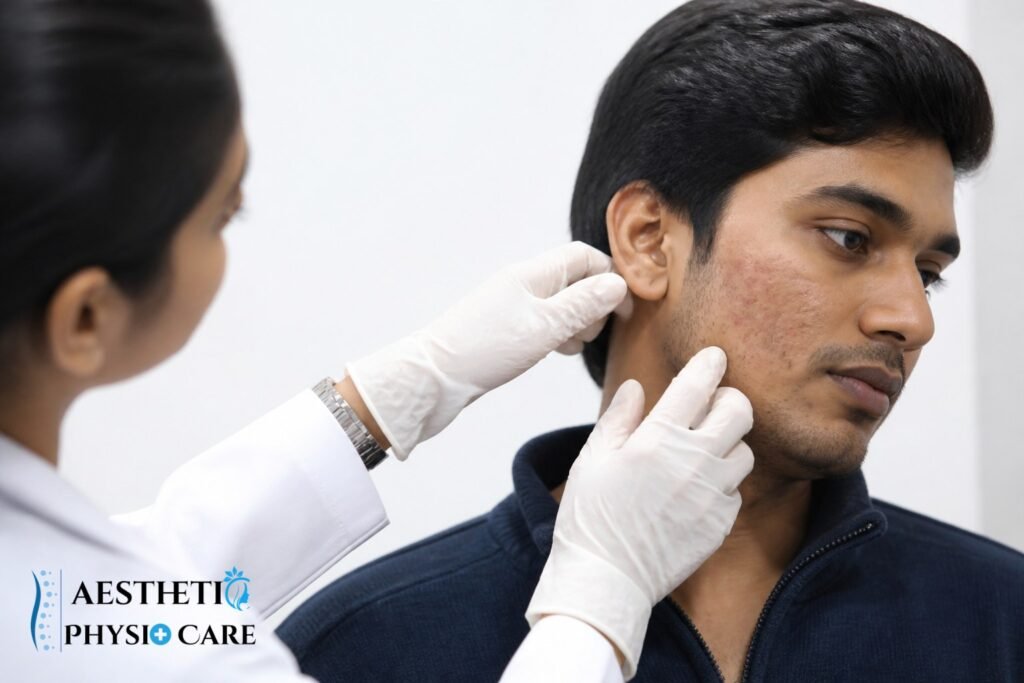
Your first visit focuses on understanding your skin rather than starting treatment straight away. We look closely at your scars under good lighting, identify the scar types present, check for active acne and dark marks, and ask about your skin history, medicines and previous treatments. We then explain which options are suitable, how they might be combined, what downtime to expect and how progress will be reviewed. You can take time to decide before booking any treatment.
What helps between sessions?
- Use broad-spectrum sunscreen every day, especially in Lahore’s strong sun
- Keep acne under control with your agreed routine
- Avoid picking spots or scabs
- Use gentle, non-irritating skincare
Book a consultation
Want to know which acne scar treatment suits your skin? Book a scar assessment at Aesthetic Physio Care in DHA, Lahore, open Monday to Saturday, 9am to 10pm. See our acne and acne scar treatment page, then message us on WhatsApp +92 339 0001855, call +92 323 4551855 or email hadia@aestheticphysiocare.com.
Frequently asked questions
Which treatment is best for acne scars on brown skin?
Microneedling and carefully chosen chemical peels are often preferred for brown skin because they carry a lower risk of pigment change than some heat-based lasers. The best choice depends on your scar types, so an assessment comes first.
Can acne scars be removed completely?
Acne scars can usually be softened and improved, but complete removal cannot be promised. Results depend on scar type, depth and how your skin responds. A realistic plan focuses on gradual improvement in texture and appearance.
Should I treat active acne before scars?
Yes. Active acne should be controlled first, because new breakouts can cause new scars and some scar treatments are not suitable on inflamed skin. Once acne is settled, scar treatment can begin more safely and effectively.
Is microneedling painful?
A numbing cream is usually applied before microneedling, so most people feel only mild discomfort or a scratching sensation. Afterwards, skin may look red and feel warm, similar to mild sunburn, for a short time.
Talk to Dr. Hadia about your situation
In-clinic in DHA Lahore or online on Zoom / Google Meet for Pakistan and the USA. Mon–Sat, 9am–10pm (PKT).