

Licensed Physical Therapist · PPTA-P 14336 · Aesthetic Physio Care, DHA Lahore · November 4, 2026
Quick answer: Exercise is one of the most important treatments for knee osteoarthritis. Strengthening the thigh and hip muscles, gentle range-of-motion work and low-impact activity such as walking or cycling can reduce pain and stiffness. Physiotherapy adds a tailored exercise plan, hands-on treatment, pain management advice and guidance on weight, footwear and daily activities.
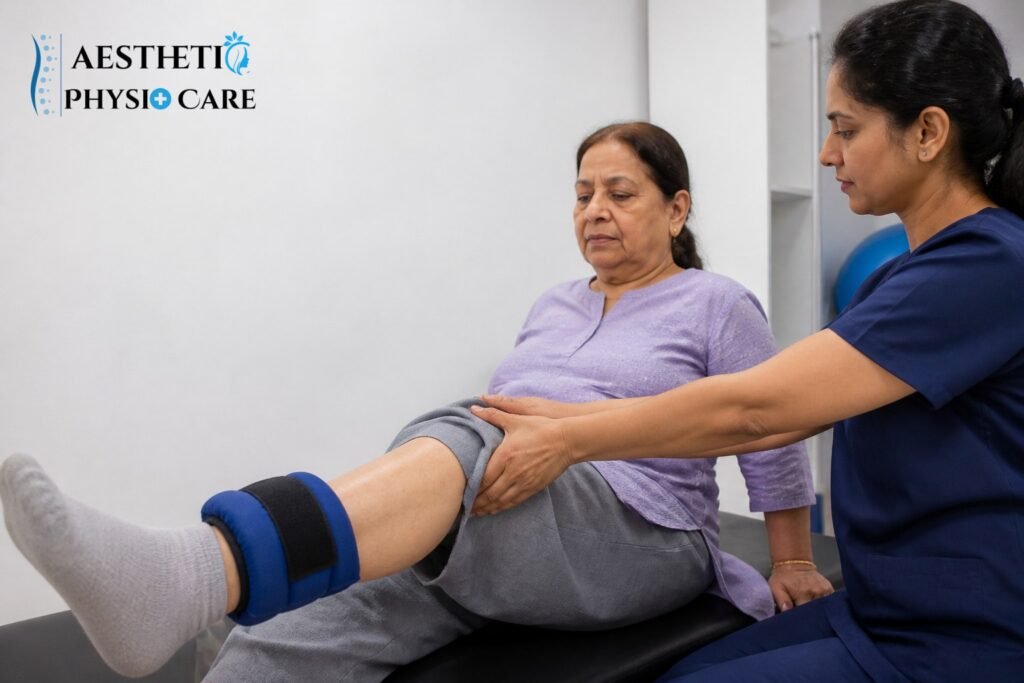
What is knee osteoarthritis?
Osteoarthritis (OA) is a common joint condition in which the smooth cartilage covering the ends of the bones gradually thins, and the joint lining and surrounding tissues change. The knee is one of the most frequently affected joints. It is more common with age, after previous knee injuries, with excess body weight and in people whose work or lifestyle places heavy load on the knees.
Osteoarthritis is not simply “wear and tear”. Joints are living tissue, and they respond to how we use them. That is why movement and strengthening play such a central role in treatment.
What are the symptoms of knee osteoarthritis?
- Pain in or around the knee, often worse with activity or at the end of the day
- Stiffness, especially in the morning or after sitting
- Difficulty climbing stairs, getting up from a chair or sitting on the floor
- Swelling, creaking or grinding sensations
- A feeling that the knee is weak or may give way
Does exercise really help knee osteoarthritis?
Yes. The NHS guidance on osteoarthritis treatment highlights regular exercise, including strengthening and general activity, as a key part of managing the condition. Stronger muscles around the knee help absorb and share load, which can ease pain and improve how the joint moves. Exercise also supports healthy body weight, sleep and mood.
It is normal to feel some mild discomfort while exercising. A general guide is that pain should settle within a day and should not keep getting worse from one session to the next. A physiotherapist can help you find the right level.
What exercises help knee osteoarthritis?
These are common starting exercises. Move slowly, stay within a comfortable range and stop if pain becomes sharp or swelling increases.
Strengthening
- Static quads: sitting with your leg straight, tighten the front of your thigh and push the back of your knee down. Hold, then relax.
- Straight leg raise: lying on your back with one knee bent, lift the straight leg a short way, hold and lower slowly.
- Sit to stand: stand up from a firm chair without using your hands if you can, then sit back down slowly.
- Side-lying leg lift: lying on your side, lift the top leg to strengthen the hip muscles that support the knee.
- Step-ups: step up onto a low step and down again, holding a rail for balance.
Mobility
- Heel slides: lying down, slowly bend and straighten the knee by sliding your heel along the bed.
- Seated knee bends: sitting on a chair, gently swing the lower leg forward and back.
General activity
- Walking on flat ground, building time gradually
- Stationary cycling
- Water-based exercise where available
How does physiotherapy help knee osteoarthritis?
A physiotherapist turns general advice into a plan that fits your knee, your strength and your life. Treatment at Aesthetic Physio Care may include:
| Approach | What it involves | Why it helps |
|---|---|---|
| Assessment | Strength, movement, walking pattern and daily tasks | Identifies what limits you most |
| Tailored exercise | Progressive strengthening and mobility | Builds support around the joint |
| Manual therapy | Gentle joint mobilisation and soft-tissue work | Can ease stiffness and help movement |
| Taping and pain relief options | Kinesio taping and other supportive techniques | May help you move more comfortably |
| Education | Pacing, weight, footwear and activity advice | Helps you manage flare-ups with confidence |
For older adults, we also look at balance and fall risk. Our elderly and geriatric physiotherapy service focuses on keeping people safe and independent at home.
Why is knee pain sometimes burning or tingling?
Not all knee OA pain feels the same. Some people describe burning, shooting or pins-and-needles sensations, which can point to a neuropathic component to their pain. Dr. Hadia Ishfaq, PT (DPT), lead consultant at Aesthetic Physio Care, has published research on neuropathic pain in knee osteoarthritis in the Rawal Medical Journal. This interest shapes how we assess pain: we ask not just where it hurts, but how it feels, so the treatment plan can reflect the type of pain you are experiencing.
What can you do at home to protect your knees?
- Stay active every day, breaking activity into shorter bouts if needed
- Wear supportive, cushioned footwear
- Use a chair or stool where possible instead of sitting on the floor for long periods
- Use the handrail on stairs and lead with your stronger leg going up
- Work towards a healthy weight, as this reduces load through the knees
- Use heat for stiffness, or a cold pack wrapped in a towel after activity if the knee feels swollen
When to see a doctor urgently
See a doctor promptly if your knee becomes hot, red and very swollen, especially with fever; if you cannot bear weight after a fall or twist; if the knee locks and will not straighten; or if you have calf pain and swelling, which can signal a blood clot.
Book a consultation
If knee pain is limiting your walking, stairs or prayer positions, book an assessment at Aesthetic Physio Care in DHA, Lahore, open Monday to Saturday, 9am to 10pm. Learn more on our joint pain and arthritis physiotherapy page or read about Dr. Hadia. Message us on WhatsApp +92 339 0001855, call +92 323 4551855 or email hadia@aestheticphysiocare.com.
Frequently asked questions
Is walking good for knee osteoarthritis?
For most people, yes. Walking on flat ground keeps the joint moving and supports muscle strength and healthy weight. Start with comfortable distances, wear supportive shoes and build up gradually. If walking causes lasting pain or swelling, get a physiotherapy assessment.
Should I avoid exercise if my knee hurts?
Not usually. Mild discomfort during exercise is common and is not a sign of harm. Pain should settle within a day and not steadily worsen. A physiotherapist can adjust exercises so you stay active without aggravating the knee.
Can physiotherapy help me avoid knee replacement surgery?
Physiotherapy can reduce pain and improve function for many people with knee osteoarthritis, and it is recommended before and after surgery. Whether surgery is needed depends on your symptoms, imaging and goals, which you should discuss with an orthopaedic doctor.
What is neuropathic pain in knee osteoarthritis?
Some people with knee osteoarthritis feel burning, shooting or tingling pain, which suggests a nerve-related component. Recognising this helps shape treatment. Dr. Hadia Ishfaq has published research on this topic in the Rawal Medical Journal.
Talk to Dr. Hadia about your situation
In-clinic in DHA Lahore or online on Zoom / Google Meet for Pakistan and the USA. Mon–Sat, 9am–10pm (PKT).