

Licensed Physical Therapist · PPTA-P 14336 · Aesthetic Physio Care, DHA Lahore · November 6, 2026
Quick answer: ACL rehabilitation usually moves through clear phases: calming swelling and restoring movement, rebuilding strength, then running, jumping and sport-specific drills. Most people need many months before a safe return to competitive sport, and the decision should be based on passing strength, hop and movement tests rather than the calendar alone. A physiotherapist guides each stage.
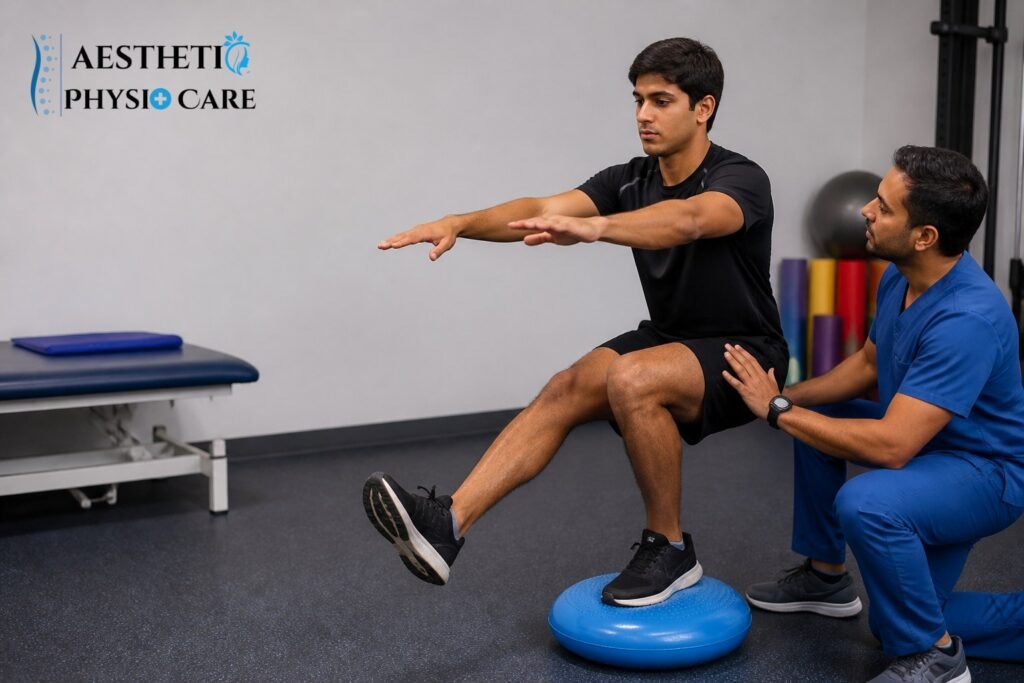
What is an ACL injury?
The anterior cruciate ligament (ACL) is one of the main ligaments holding your knee stable. It stops the shin bone sliding forward and controls twisting. ACL injuries often happen in sports that involve sudden stops, pivots or awkward landings, such as football, cricket fielding, basketball, badminton and squash.
Common signs include a “pop” at the moment of injury, fast swelling, pain, and a feeling that the knee gives way. Some people can walk soon after, which is why the injury is sometimes missed. If your knee swelled quickly after a twist, get it assessed rather than playing on.
Do you always need surgery for a torn ACL?
Not always. Treatment depends on the type of tear, other damage inside the knee (such as the meniscus), your age, your sport and your goals. Your orthopaedic surgeon decides whether reconstruction is right for you. Some people who do not return to pivoting sports manage well with a structured physiotherapy programme alone.
Whether or not you have surgery, physiotherapy is central to recovery. Many surgeons also recommend “prehab” before an operation: reducing swelling, getting the knee fully straight and building quadriceps strength. A knee that goes into surgery moving well tends to be easier to rehabilitate afterwards.
How long does ACL rehabilitation take?
There is no single number that fits everyone. After reconstruction, return to competitive pivoting sport commonly takes many months, often around nine months or more, and rushing back is linked with re-injury. The timeline below is a general guide only. Your surgeon’s protocol and your own progress always come first.
| Phase | Typical focus | Milestones before moving on |
|---|---|---|
| 1. Early recovery | Swelling control, full knee straightening, quadriceps activation, walking pattern | Knee fully straight, minimal swelling, straight-leg raise without a lag |
| 2. Strength and control | Progressive leg strengthening, balance, bending range, cycling | Good single-leg control, near-full bend, normal walking and stairs |
| 3. Running and agility | Straight-line running, landing technique, lateral movement | Pain-free running, good landing mechanics, strength close to the other leg |
| 4. Sport-specific training | Cutting, pivoting, sprinting, drills from your sport | Passing return-to-sport tests, confidence, full team training |
| 5. Return to sport | Gradual match exposure and ongoing injury prevention | Cleared by your surgeon and physiotherapist |
What happens in the first weeks of ACL rehab?
The early weeks are about protecting the knee while getting it moving. Priorities usually include:
- Getting the knee fully straight. Losing extension early can cause a limp and long-term problems, so this is a top goal.
- Controlling swelling with ice, elevation, compression and sensible activity levels.
- Waking up the quadriceps with exercises such as static quads and straight-leg raises.
- Walking well, with crutches or a brace if your surgeon advises, until you can walk without limping.
When can you start running after an ACL injury?
Running is earned, not scheduled. Before you start, your physiotherapist will usually check that you have little or no swelling, a full or near-full range of motion, good single-leg balance and enough strength to control your knee on hopping and step-down tests. Running then starts gently, often with short intervals on flat ground, and builds week by week.
How do you know you are ready to return to sport?
Feeling fine is not enough. A good return-to-sport decision combines several checks:
- Strength testing comparing the operated leg with the other leg, especially the quadriceps and hamstrings.
- Hop tests such as single, triple and crossover hops for distance.
- Movement quality, watching how your knee lines up when you land, cut and decelerate.
- Psychological readiness. Fear of re-injury is common and worth addressing directly.
- Clearance from your surgeon, with gradual exposure to full training before matches.
What can you do at home to help ACL recovery?
- Do your home exercises consistently. Small daily sessions beat occasional long ones.
- Keep a simple log of swelling, pain and what you did that day. Patterns help your physiotherapist adjust the plan.
- Sleep well and eat enough protein to support tissue healing and muscle building.
- Stay fit safely with upper-body work or cycling if cleared.
- Avoid “testing” the knee with sudden twists or casual games before you are cleared.
When should you seek urgent medical help?
Contact your surgeon or a doctor promptly if you notice:
- Increasing redness, heat, wound discharge or fever after surgery
- Calf pain, swelling or tenderness, or sudden breathlessness or chest pain, which need emergency care
- A knee that suddenly locks and will not straighten
- A new giving-way episode with fresh swelling
How can physiotherapy at Aesthetic Physio Care help?
At our clinic in DHA, Lahore, ACL rehabilitation is led by Dr. Hadia Ishfaq, a Doctor of Physical Therapy with experience in the Orthopedic and Spine OPD at Lahore General Hospital. Each programme follows your surgeon’s protocol and is adjusted to your sport, whether that is club cricket, gym training or competitive football. Learn more on our sports injury rehabilitation page, or see our wider post-surgery orthopaedic rehab service.
If you live elsewhere in Pakistan or in the USA, an online physiotherapy consultation can help you review your exercises and plan. Online sessions are advisory and do not replace an in-person exam by a provider licensed where you live. For general background, the NHS overview of physiotherapy is a helpful read.
Book a consultation
Ready to plan your road back to sport? Message us on WhatsApp +92 339 0001855, call +92 323 4551855, or visit our contact page. We are open Monday to Saturday, 9am to 10pm.
Frequently asked questions
How long after ACL surgery can I walk normally?
Many people walk without crutches within the first few weeks, but this depends on your surgery, any meniscus repair and your surgeon's protocol. The key goals are a fully straight knee, controlled swelling and no limp. Your physiotherapist will tell you when it is safe to stop using crutches.
Can I recover from an ACL tear without surgery?
Some people can, especially if they do not play pivoting sports and their knee feels stable with daily activity. A structured physiotherapy programme focusing on strength and control is essential. Your orthopaedic surgeon and physiotherapist will help you weigh the options based on your knee, lifestyle and goals.
Why is it risky to return to sport too early after ACL surgery?
The new graft needs time to mature, and your muscles need time to regain strength and control. Returning before passing strength and hop tests increases the chance of injuring the knee again. Basing the decision on objective tests, not just time or feeling good, is the safer approach.
Can I do ACL rehab sessions online?
Online consultations can help you review exercises, technique and progression, and are useful if you live outside Lahore or in the USA. They are advisory and do not replace hands-on assessment and testing by a physiotherapist or doctor licensed where you live.
Talk to Dr. Hadia about your situation
In-clinic in DHA Lahore or online on Zoom / Google Meet for Pakistan and the USA. Mon–Sat, 9am–10pm (PKT).